


Nobody calls unless there’s a crisis, but suddenly my phone is ringing, my inbox filling with texts. Old friends, parents from the kids’ school, family. Offering congratulations, sharing photographs, videos. I’m on the toilet composing a joke when a family friend phones, a man who in my first hours of life burst into the hospital room and sent my newborn crib careening towards the wall. Why would he call, I think, unless somebody’s dead?
“I just wanted to check if you’ve recovered from last night?” the family friend says. He describes a nightmare: it’s the final day of the season, Arsenal are losing, Manchester City have won the title again. He woke sweating. “I think you need therapy,” his therapist wife told him. “You’re losing sleep over a football team.”
I can’t cope, the head of the parents’ network texts. I am drinking, want vomit, texts a Canadian friend I helped turn into an Arsenal fan, I need a new hobby after this season. Quantum mechanics, I want to suggest. Open heart surgery.
“Doesn’t someone have to win?” Stef asks. “Why does anybody care?”

I was seventeen and hungover when the final whistle blew at Highbury, 15th May 2004. Arsenal had been Champions for weeks, and I had spent the night before at a party where I’d drunk until I threw up, then kept drinking. I didn’t want to stand for ninety minutes in a screaming crowd, in the glare of the afternoon sun. I wanted to be at home, curled on the sofa, sipping water to soothe my stomach, losing myself in the strobing colours of MTV.
I wasn’t expecting, when the match finished, crowds of stewards to rush the pitch, carrying poles and hoardings. They were constructing a platform, while the players waited, while the crowd stayed in their seats. Eventually, the Premier League trophy, a large silver jug with handles, topped with a crown, was brought to the stage. Slowly, one by one, the players walked past it, kissed it, took their places behind it. Finally, the captain, Patrick Vieira, grasped the handles. As he raised the trophy, fireworks exploded, the crowd roared, acid surged into my throat.
Can we go? I wanted to ask, as the players paraded around the four corners of the pitch, walking in slow motion, stopping to wave and applaud the fans. Can’t we just leave?
What seventeen-year-old thinks of a moment as precious? Or sees joy as a rare treasure, easily lost, forgotten, buried under years, then decades of disappointment? In May 2004, Arsenal had been Champions for nearly a third of my life. That season, they won without suffering a single defeat, the Invincibles team that played inventive, surprising football. It was not yet a joke, one of many at their expense, but a fact that Arsenal could pass the ball into the opposition goal. Even then, sick, desperate for comfort, I wondered: could this be the last time? How long would I have to wait until it happened again?
When it became apparent on Tuesday night that Arsenal were going to win the 2025/26 Premier League, their first title in twenty-two years, I was reading a novel aloud in my five-year-old’s bedroom. My son had spent the day off school, vomiting, floppy, panting. Too weak to walk, or even at times to lift his head. My clothes, Stef kept reminding me, were vomit clothes, sprayed with droplets, a towel for my son’s naked, shivering body.
My son lay on his mattress, knees pulled up to ease his pain, his face tight. From the rocking chair beside his bed, I read a page, fed him water, read a page, fed him Calpol, read a page, brushed his teeth, offered him the sickbowl, read a page.
Here we go, texted a friend, a recent convert to Arsenal. I think tonight is the night.
In the panic about my son, I had forgotten the match between Bournemouth and Manchester City. City’s penultimate game, they needed to win to have any chance of overtaking Arsenal, of once again winning the title on the final day of the season. On my screen, the replays were showing the goal Eli Junior Kroupi had scored. Bournemouth were winning 1-0.
For the last few weeks of this season, as Arsenal and City raced towards the final day neck-and-neck, my mind kept returning to the same period of 1999. Then, as this season, Arsenal were in a footrace, but with City’s derby rivals, Manchester United. Then too, the outcome was in Arsenal’s hands. If Arsenal won their final five games, they would be Champions. But in the penultimate game, on a Tuesday night in Leeds, Arsenal slipped to a loss.
At the time, it seemed that defeat had not been fixed by a late header at Elland Road, but weeks earlier, in a replayed FA Cup semi-final. Against United, the eventual treble winners, Arsenal’s Dutch magician Dennis Bergkamp missed a last-minute penalty. In extra time, Ryan Giggs scored a breakaway wondergoal.
I was eleven years old, allowed to stay up late, to watch till the final whistle. I went to bed weeping. My parents came in to comfort me, one by one. A few weeks later, my mother would tell me they planned to separate. By the time the new football season began, my father would be sleeping in the spare room, before moving into another home entirely. The family breakup would be commemorated in the four season tickets I still share with my father and brother, the fourth seat that first seemed to mark the absence of my mother, then the presence of my step-mother, and which for two decades has passed among friends, the occasional subject of debate or negotiation, waiting for somebody – my son, perhaps, if he wants it – to claim it as a birthright.
As I lay crying, I replayed the match in my mind. Bergkamp stands over the penalty. He sends the ball the other way, and the full-time whistle blows. The wayward pass falls to Ryan Giggs, who cannot beat the Arsenal defender, or trips, injures himself, fluffs his shot. It’s the Arsenal players lying on the turf, spread out in joy, the United players who sink into crouches, squeezing the tears from their eyes. I was crying the way I had cried as a child, uncomplicated, free-flowing tears, because I was still a child, if only for a few more weeks.
“Just be glad you’re crying,” my mother said, sitting at the foot of the bed. “There’ll be people out smashing windows.” The emotion, was her point, would come out somewhere.
On Tuesday, after my son fell asleep, I showered and sat in bed, in pyjamas, watchful for any churning in my stomach. The Manchester City game played on my phone, beside the baby monitor, a grey-and-white portrait view of my son’s sleeping body. Unless City scored two goals, Arsenal would win the title. Arsenal, a team that had fallen short for twenty-two years, that had become the butt of endless jokes about failure.
What am I more afraid of, I wrote in my notebook, Arsenal losing the title, or winning it?
Twice, the Bournemouth right winger, David Brooks, was put through on goal. He tripped over one shot, sent another flying into the post. I wanted another Bournemouth goal, something to put the result beyond doubt. Perhaps if I had half an hour, twenty minutes, I could relax, I thought. Get used to the idea Arsenal were going to be Champions.
In April, Erling Haaland, the fastest player to score a century of Premier League goals, twice a title winner with City, mocked Arsenal’s loss to Bournemouth, proof that Mikel Arteta’s team were spent. Now, in injury time, Haaland put the ball in the Bournemouth net. 1-1. City needed one more, with only two minutes left to play.
Surely they couldn’t. A last-minute, last-gasp winner. Surely it wouldn’t happen again.
I feel sick, I wrote.
I’ve been calling this the Schrödinger season. Every certainty has proved uncertain. Arsenal pulled nine points clear, a decisive lead that evaporated. They lost four times in a month, twice to City, going out of two domestic cups (City won both). We’re toast, I texted friends.
Toast. Champions. We would be one or the other. For weeks, months, we were both.
Stef came into the bedroom carrying dirty bedding. Our daughter had the virus, and Stef’s stomach was beginning to turn. “How’s the football?” Stef asked.
“We’re Champions,” I said.
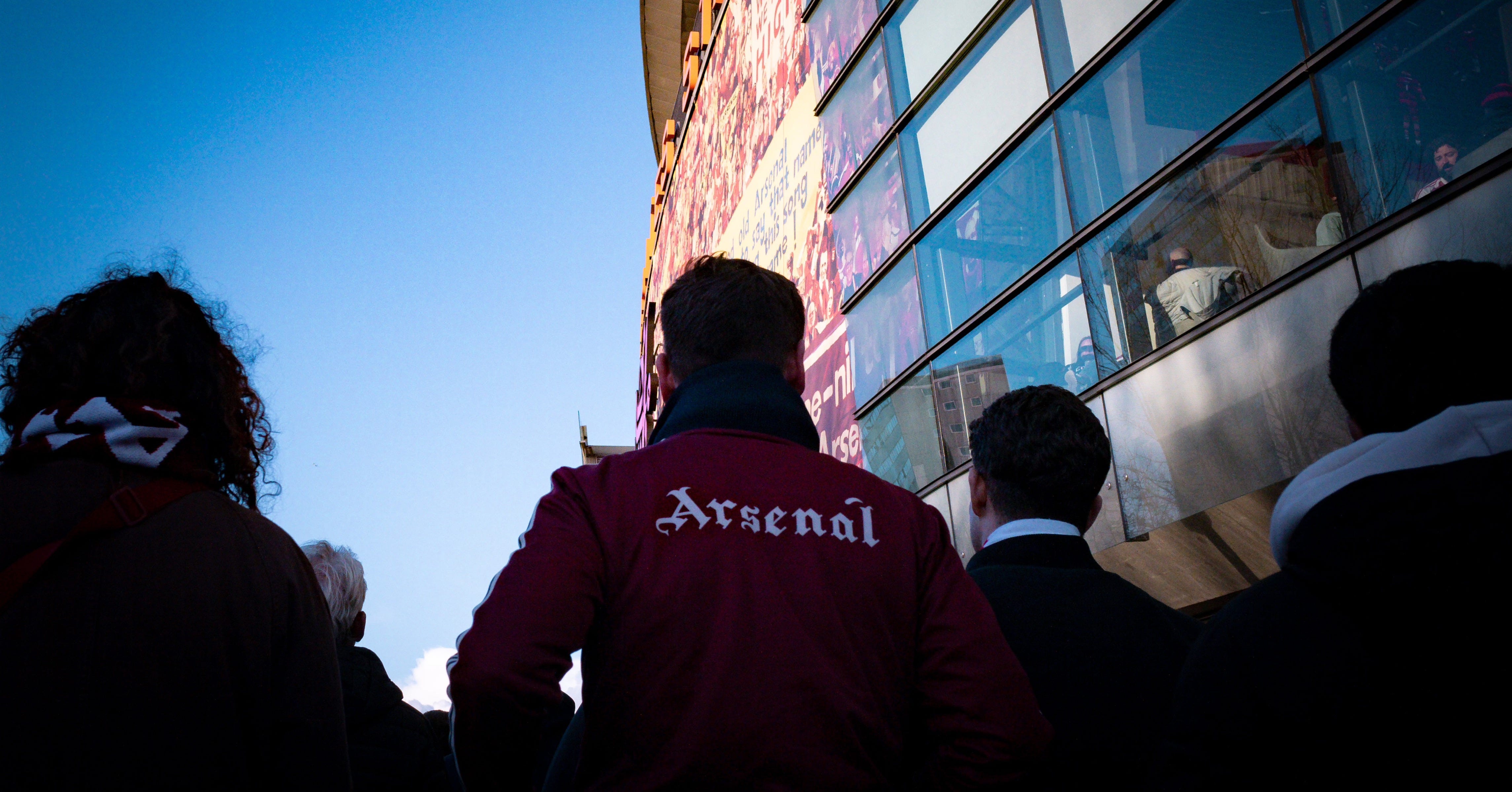
Already, people were texting, congratulating me, as if my angst had helped the team to victory. Telling me they were going to the Emirates Stadium, where crowds were already gathering.
I don’t know what to do with myself, one friend texted.
Experiencing the moment through my phone, atomised, disconnected, listening to my son panting through the monitor in his bed – wrapped in worry, who would care for our sick children if we got sick, who would care for us – I knew I could not go through this alone. I needed to get to the ground, to be surrounded by smiling faces, to lose my weak voice in a chorus of chanting.
Pictures were arriving. Flares, flags, faces lifted with glee. A video of Ian Wright, once Arsenal’s top scorer (ten years old, I watched from the stands as he lifted his shirt to reveal a Nike-branded undershirt, 179 – JUST DONE IT). Wrighty danced through the scrum, accepting hugs from everybody he touched.
Never experienced anything like it, texted my Canadian friend. He, too, had hugged Ian Wright. Was like a healing.
In the morning, everyone is well except my son. He seems better when he wakes, chatty, smiling. He drinks a glass of water, but he’s too weak to stand, and the effort makes him lie down, pressing his face into his mattress, clutching his stomach, moaning. Shortly afterwards, he throws up water, filling the sickbowl.
He can’t eat, I write. Can’t stand. He should be beating this by now. Why won’t his temperature come down? Why isn’t he getting better?
My son asks for food and refuses water. I bring him a pinch pot of dry cereal, which he finishes. He drinks a glass of water and asks for more food.
“Not yet,” I say. I have refreshed the sickbowl and place it beside him. I watch warily as he climbs out of bed and walks to his desk.
“Let me see if I can walk to the other room,” my son says. His footsteps pad across the floorboards. His subvocalised commentary comes murmuring through the wall. I made it to the chair, he says. Look, I made it to the bed. My face relaxes. I am smiling. My son has beaten the virus. And Arsenal – Arsenal are Champions.
More Stories:


Thanks for reading One More Draft! Pocket Lint is a nutritious weekly serial, fortified with trivia and nonsense, now available in a convenient fictional wrapper. If you didn’t enjoy this post, be sure to miss the complete Pocket Lint Archive. Feel free to provide feedback through my Complaints Form, and do comment and share to help others avoid my work.
Until next week, with warmth and gratitude,
LW
unsubscribed
I’m so glad you decided to write/publish this. I really enjoyed reading it, a wonderful piece all around, congrats on the win and your son’s recovery.