


The first night, Juliet throws a whiskey tumbler, and Karl calls it their Kristallnacht. She asks what that’s supposed to mean. Is he calling himself a German Jew? Is he calling her a Nazi thug?
In fact, they’re both Jewish. Her grandmother left Germany as a baby. Juliet’s great-grandfather stayed behind to keep his shop on a Munich boulevard, repairing eyeglasses.
To give them relaxation time before the conference, Karl switched their flights at the last minute. As they came in to land, a day early, something flashed past the starboard windows. Karl took a photograph of the smoke trails racing into the sky. When their taxi dropped them, tongues of flame licked from a blackened hole in the tower opposite their hotel.
Because of the rockets, the conference is cancelled, but so are flights. Their room is on a high floor overlooking the ocean. Through the pink and purple dusk, pillars of smoke rise from distant missile launchers and arc over their heads. Karl fetches a bath towel to sweep up the broken glass. “It was a joke,” he says. “Kristallnacht. It doesn’t symbolise anything.”
There’s a room service trolley Karl ordered, but Juliet can’t eat. She sits on the sofa scrolling the news. The stress has done no harm to Karl’s appetite. He smears butter onto a crust of baguette, while an American with pink eyes and liver spots tells her war is an ocean current, it swells and ebbs. When the video stops, she becomes aware of an ominous tone repeating through the walls.
“Do you hear that?” she says, remembering too late they aren’t speaking.
“Hear what?” Karl says aggressively. He’s always accusing her of hearing, smelling, seeing things that aren’t there. He takes a bite out of a club sandwich and flinches. Bacon, tomato, slices of chicken slide onto the tablecloth. A siren from a movie is screaming. The military base is under attack. A nuclear power plant is in meltdown. The alarm comes from Karl’s phone at an excruciating volume. Then it comes from Juliet’s phone.
“It’s okay,” Karl says. “I asked Grok.” The emergency message tells them to seek urgent shelter, away from high floors. “There’s a shelter down the street.”
Riding the lift down, she wonders what they will find outside. Is there panic? Or has the city reorganised itself for post-apocalyptic survival? Will she be obliged to loot?
The deserted avenue smells of lime juice and barbecued hair. Everyone’s safe inside basements, carparks, panic room bunkers. Car engines hum in the distance, and she hopes the engines only belong to cars. Karl steers her down an alley of bins and across another main road. They enter a network of tarmacked passages. “This is it,” Karl says, rapping a shutter.
Against the building, someone has left a cat climber. It’s marshmallow pink and shaped like a furry birthday cake. A yellow streak of dog urine, she hopes it’s dog, runs down the outside of the cake and between their feet. “It must be a hallucination,” Karl says. He puts his arm around her while he asks Grok for another shelter, a real one. She thinks that’s a bad idea, but if she speaks she’ll cry.
A light shines in her eye, goes out, then shines again. They are standing at a crossroads between six passages. The buildings are wedges, and from a first-floor window a curtain is pulled back, exposing a spotlight. A figure peers out, calls something, and closes the curtain.
A shutter beneath the window rattles halfway open. “In here,” a hunched woman says, crouching to speak. “It’s not safe on the street.”
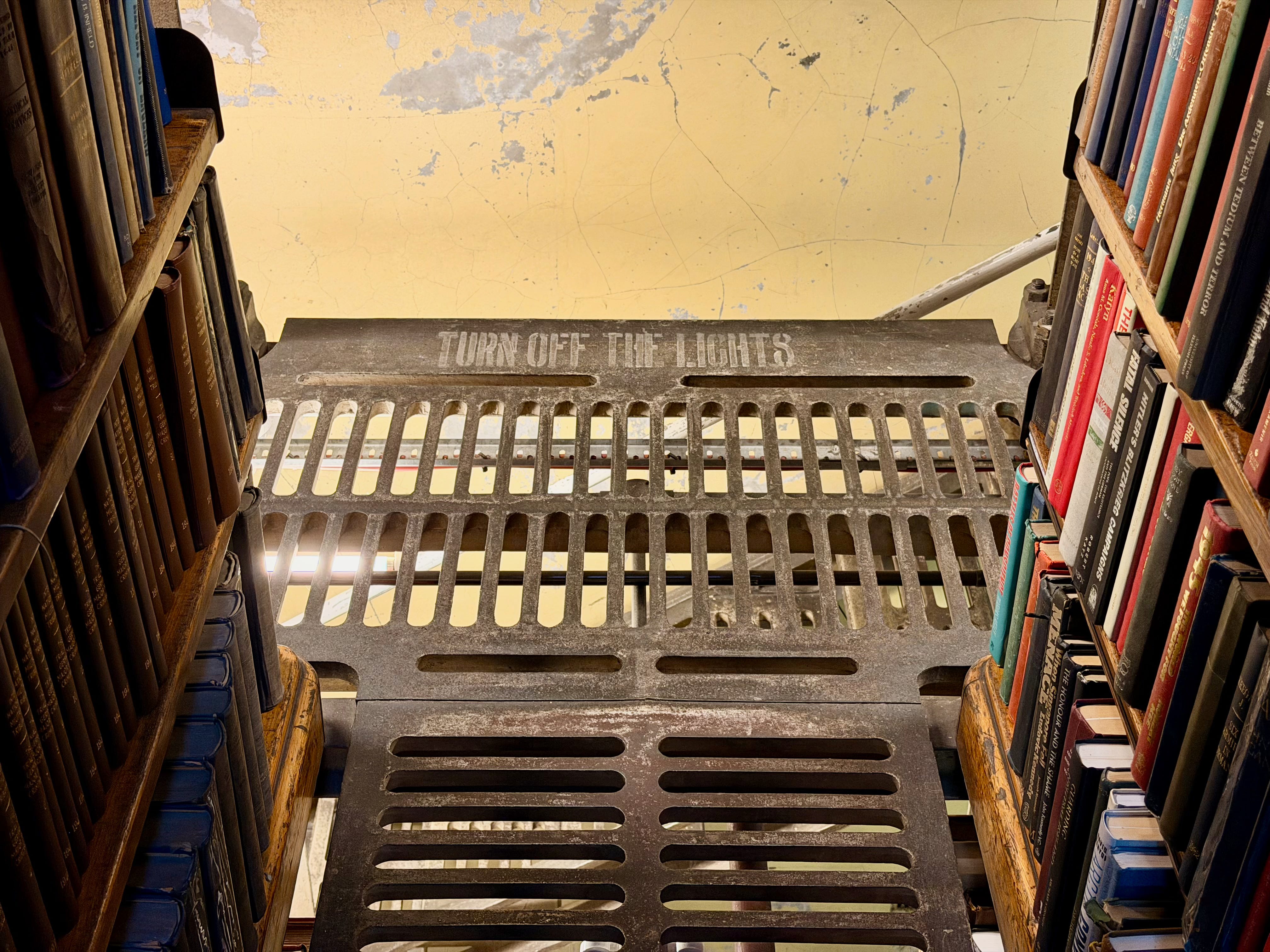
They scramble under the shutter. The building is a library, full of people. They are in the storage stacks, metal shelves that move on wheels. People have fitted themselves into every nook, families with children, youths in sports shirts, a group of white-haired men with matching silver earrings. The hunched woman leads them, speaking into a headset. “That’s good,” she says. “That’s good. That’s good that’s good that’s good. It’s good.” In the lobby, teenagers have made a tennis court out of books. They use books for paddles, beating balled fliers over a book net. In the reading room, families make sleeping arrangements between the shelves, piling up books for walls and beds.
The woman takes them upstairs to a corner high in the stacks. Stuffed animals and toy cars and sports bags full of pyjamas already lie on the metal walkway, and the woman shuffles them into the corridors without checking which family they belong to. She ends her call and introduces herself as Maria, the librarian. “You’ll have to excuse my rudeness,” Maria says. “I’ve lost a word.”
Karl picks a book off the shelf. Their section is Greek drama. “You’re in the right place,” he says.
They sit on the floor, while the families pile up books to wall them in. Through the holes in the metal, Juliet hears mothers mutter about cleanliness, sleeping arrangements, where everyone will wash and eat. Children question one of the fathers. Are pigs mammals? Are humans? What is the difference between a hero and a god? Each time the man addresses one of the children, the others howl. “I wanted you to answer mine first.”
Juliet picks a Sophocles revenge tragedy for a pillow. Karl chooses Aristophanes, the women who withhold sex to end war. She can still taste the hotel wine. Her wrist still carries the perfume she sprayed before the Uber to the airport. They were halfway across London when the app crashed, cancelling the job. “How can we live like this?” the driver asked Juliet, meeting her eye in the mirror. They could have turned around and gone home, she thinks, lying on the walkway, the hard metal scratching through her T-shirt, catching on skin and bone.
As she sleeps, phones buzz, alarms start chirruping. The noises are nothing like the emergency alert, but people scream anyway. “It’s very disturbing,” Karl calls out, waking Juliet from a dream. She remembers it in the morning. She and Karl were Greek gods, invisible monsters. In the dream, they went from place to place, trying to get back to Mount Olympus. As they went they turned into eagles or visiting strangers, whispering promises that filled the people they met with furious passions. They had to pass their flat in Clapham, just as a rocket came streaking down from the sky. Juliet turned it aside with the hem of her robe and Karl caught the rocket in his great fist and hurled it into the sun.
The book walls have grown. When Juliet stands, she cannot reach the top. Neither can Karl, even when he jumps, even when he climbs the shelves. They lean their shoulders against the spines and heave. Children, attracted by their grunting, peer down from the tops of the walls. They throw down duvets and pillows. “You’re our prisoners,” they call. “We want you to be comfortable.”
“I’ve bought a typewriter,” Karl says. They are sitting on the duvets, back on their phones. “They’ll deliver it next week.”
“Here?” Juliet asks, but he means home, London.
“These wars don’t last forever,” he says. “They’re like the tide.”
She can feel the tears rising again, but the children are watching from the high walls, taking turns with binoculars. “Why is everything the opposite of what it should be?”
“Don’t cry, Eva Braun,” Karl says. He bends to inspect a box, and Sophocles flies over his head. “They gave us a chessboard.”
He stacks books for a table and sets up the pieces. As he plays, his expression tightens with grief. He hates to beat her, and she does not know she’s beaten when he inhales sharply.
“Is that checkmate?” she says.
“You tell me.”
“It’s not even check.”
But she’s wrong. Karl moves the pieces back, replaying the last moves. “Pay attention,” he says. “You’ll see how easy it was to stop me.”
Thanks for reading One More Draft! Pocket Lint is a nutritious weekly serial, fortified with trivia and nonsense, now available in a convenient fictional wrapper. If you didn’t enjoy this post, be sure to miss the complete Pocket Lint Archive, and do comment and share to help others avoid my work.
Until next week, with warmth and gratitude,
LW
I enjoyed this. But this section:
“passages. “This is it,” Karl says, rapping a shutter.
Against the building, someone has left a cat climber. It’s marshmallow pink and shaped like a furry birthday cake. A yellow streak of dog urine, she hopes it’s dog, runs down the outside of the cake and between their feet. “It must be a hallucination,” Karl says. He puts his arm around her while he asks Grok for another shelter, a real one. She thinks that’s a bad idea, but if she speaks she’ll cry.”
It wasn’t clear to me what Karl’s ‘it’ was. The shelter I worked out. And then the significance of that object - tell me cat climber out of context and I didn’t pick up on what it was. And then it’s ’like a cake’ and then you say it is a cake. You signify the urine - is there an ascending or descending scale of urine, one being better than another? And finally because there’s a cat climber there does that mean it’s not a shelter?
Ha. And now I’ve written a lot. But like I said I like this a lot.
Excellent, especially the ending