


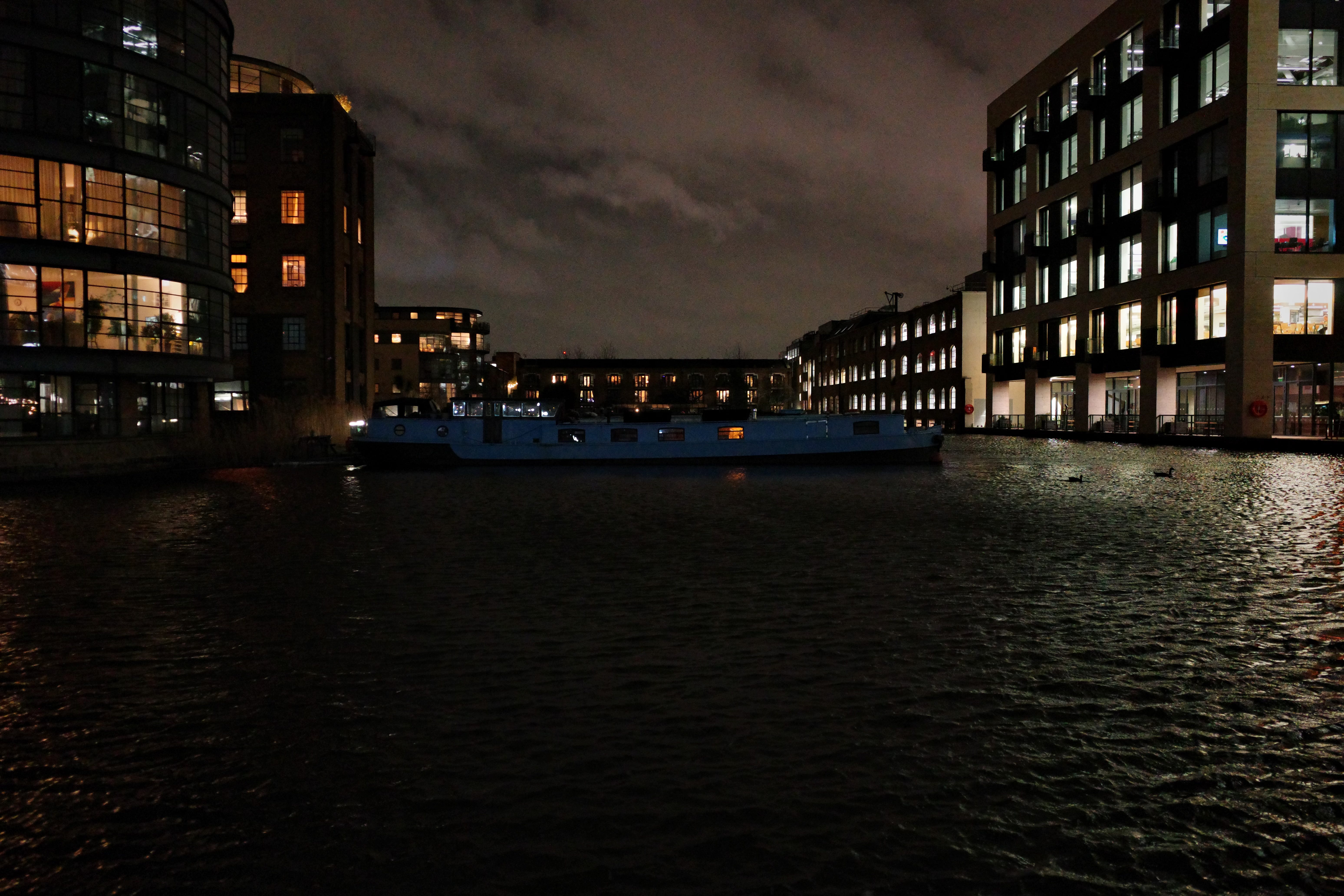
After his second glass of wine, Toby walks home along the towpath, past the silent-swimming ducks, rippling shadows in the dark. His steps are light, incautious, but he listens for the whirr of a bicycle chain, the moan of a lost duckling. Ahead, by a canal boat, a man in an overcoat with grey hair steps aside to let a group of youths come by. The youths wear tracksuits and smirks that emerge through the clouds from their vapes. One boy stumbles on a mooring, and the older man catches his elbow.
It’s a dark night. Above the towpath, passing the estate, Toby finds himself accelerating. The walkways of the block are brightly lit. A police van loiters, brake lights glowing. Toby slows, alert, but the scene is peaceful.
Soon he is passing the floodlit football pitches. Toby captained the firsts at university, and he still keeps his foot in on Saturday mornings, coaching local boys. He knows the families in the townhouses opposite the park, and the muted lights of the bedroom windows make him imagine himself running up the front door steps, pounding the knocker, sweating, shouting, “Help, help, help.” Bleary dads brightening as they open the doors. “Tobes. You’re out past bedtime.” Leaning their bald spots through the doorway to survey the deserted street, the mocking crescent of the moon.
*
Toby was sober when he left the house earlier that evening, stepping into unexpected dark. It was the tail of March, a time of year that made him think of the pandemic, those early lockdown sunset dinners in their terrace garden, warm and safe in their prison. But a cold snap had blown a chill into the evening.
On the street beside his own, Toby paused to take a photograph for his Instagram. There was no method behind the pictures he posted, just the things that struck him as he walked the streets. Usually, empty roads, dark shadows, an unexpected gleam of neon.
Tonight, it was a fridge, an integrated fridge-freezer, left beside a builder’s hoarding, facing the parked cars on the diagonal. Approaching headlights made the fridge a white canvas showing Toby’s silhouette: the contours of his hair and ears, the stiff shoulders of his overcoat.
As he took the photo, footsteps came around the fridge, a hunched figure. Toby quickly turned and walked away, aware of being followed, imagining the person tapping his shoulder. Excuse me, did you just take my picture?
*
At the photography exhibition, Toby took a glass from a waiter’s tray, telling himself he’d only have the one. He’d been invited by his university friend, Chris. With his hand shaking on the stem of his wine, Toby scanned the crowd on Chris’s behalf. Chris and his fiancée, Madeleine, had been known as the codependent legal couple who did everything together and agreed on nothing. They’d been together since law school and nobody, least of all Chris, who’d instigated it, had seen the breakup coming.
The cause had been a car crash. Chris wasn’t in the car with Madeleine, or even in the same country. Maddie was visiting her brother in Singapore when her taxi turned over. She texted Chris from the ambulance: I want you to know I love you. The text reached Chris in Prague, around the time a stripper was pushing his face inside her bra. It was a stag do, and when he discovered the message in his inbox the following lunchtime, marked read, he understood that Madeleine had thought she was going to die. I told her straight, he’d texted Toby at the time. You deserve somebody who cares enough to stop the lap dance.
Since the breakup, Chris had been scouring Substack newsletters for gallery openings, regionally authentic industrial-estate restaurants, clubnights with sadomasochist-coded themes. These last three months as wingman were the most Toby had seen Chris since graduation. Toby’s girlfriend, Fi, had him under instruction to keep an eye on the women Chris hooked up with. Fi had taken Chris’s side in the breakup. He’d behaved badly, she conceded. But she’d never liked Maddie to begin with, and since the proposal, she couldn’t stand her.
*
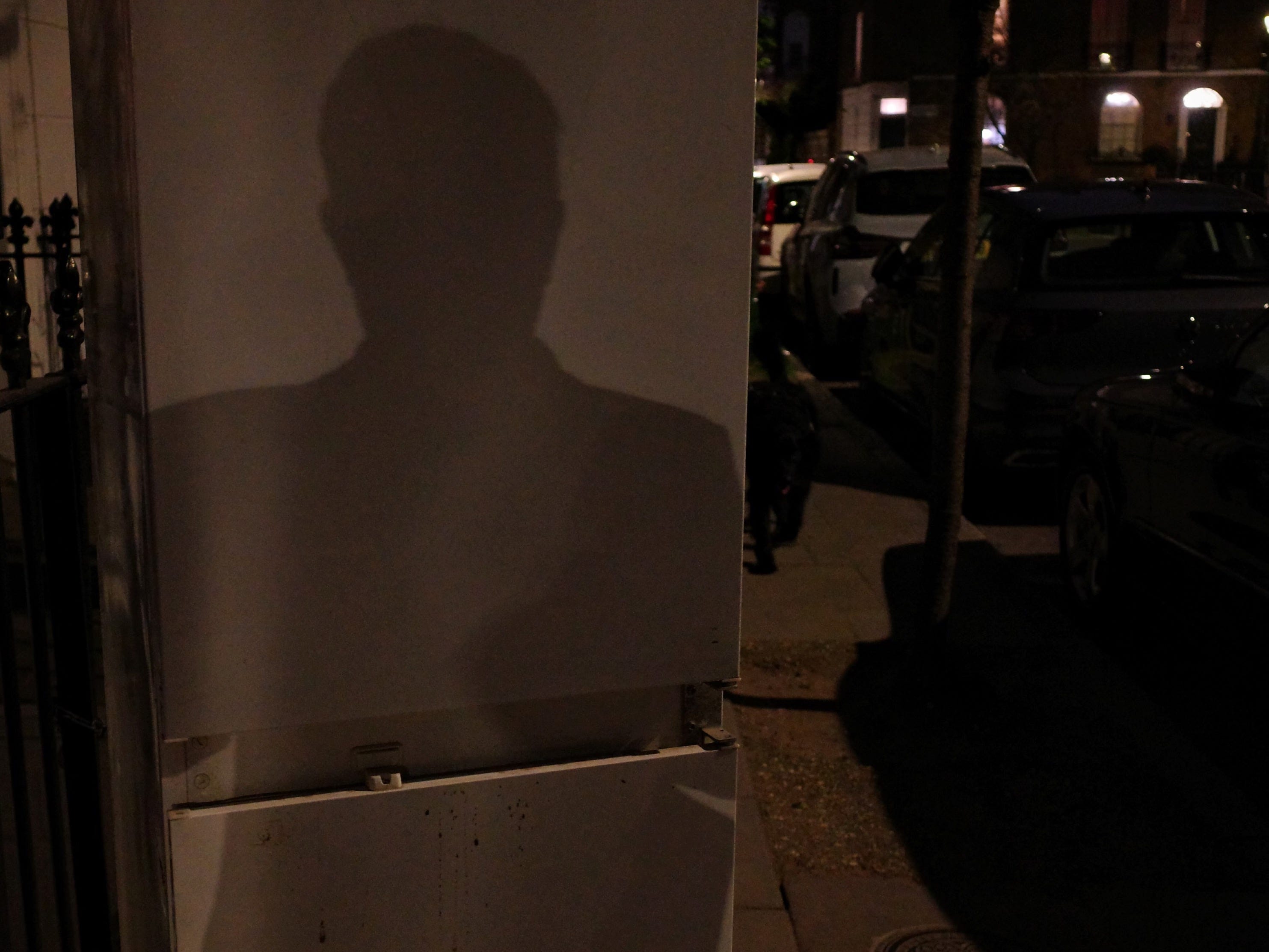
Walking away from the fridge, footsteps clipping behind him, Toby wondered about his responsibility. The steps sounded like a woman’s nervous haste, and he worried that if he kept walking ahead he’d be contributing to her terror. He stepped to the kerb, planning to cross, and saw that the person following him was a broad man in a puffer jacket, trailing a thick-necked hound.
Toby raised his phone, but there was nothing to photograph on the dark street. Only closed curtains, puddles of light from the streetlamps. He let the man with the dog pass, the dog’s panting, the man’s quiet grunts. The pair stopped at the corner in a cone of light and Toby swung his camera, but too late. They were gone, around the corner, lost to the night.
Toby followed. He was standing on the same corner, debating whether to turn left and risk the sketchy park with the floodlit football pitches and the dark canal towpath, or whether to continue straight down the hill to the main road. From somewhere ahead in the dark, a weak voice, a sickbed voice, called out, “Help. Help. Help.”
*
At the opening, Chris told Toby about a case he’d won, a woman who sued her employer for workplace bullying, harassment, discrimination. They were standing in front of a photograph through the window of a flat, four paint syringes sitting on a draining board beside a plate of blackened toast, two police officers in yellow vests reflected in the dusty glass, looking over their shoulders at the photographer.
There were emails and text messages, but Chris had managed to exclude them. The case rested on the woman’s testimony, which was heartbreaking. She cried describing the tampons her supervisor had left in her tea, the pinup photograph, her head superimposed, blu-tacked inside the urinal. Chris was sure he’d lost, but the tribunal found against the woman. Even after watching her cry.
“What about her?” Toby said, waving his empty glass towards a woman in a bright blue overcoat, her hair dyed blue, yawning in front of another window photograph, this one of a sill crowded with crosses, each carrying a Jesus who faced the backside of a closed blind.
Chris sniffed. “She’d have found against me, for sure.”
“You feel responsible?”
“It’s my job to defend my client the best I can. Who’s to say the panel got it wrong? Maybe the whole thing was a fantasy.”
*
The words still echoed in Toby’s ears on the street corner, as he peered into the darkness of the falling hill. Help. Help. Help. There was something unusual about the voice, something he couldn’t penetrate, as if the night itself had produced it. He thought he could make out some sort of activity in the shadows across the road. On the far side of a streetlamp, there, against a white wall. Limbs. Movement.
Slowly, Toby pieced together figures. There were three bodies pressed close around something in the darkness. The bodies were short, skinny, dressed in black. Teenagers, Toby thought. Their voices indistinct, angry. They surrounded something he couldn’t make out, perhaps only the wall itself. A flash of light might have been a mobile phone in one of the youths’ hands.
“I’m filming you,” one of the boys said. Or Toby thought he said. “Bruv, I’ve got you on camera.”
*
One of Chris’s clients was fired because a customer accused him of being a pervert. Another was a delivery driver beaten up on a sink estate by a gang filming for YouTube. “It didn’t seem real,” Toby said, in front of a photograph of a glossy magazine devoted to the stoic philosopher, Seneca. A pair of sunglasses, missing one arm, lay across the title of the magazine, casting amber shadows.
“Guess who I came up against in court,” Chris said, typing into his phone.
*
Toby had his phone in his hand. He could photograph the scene. The youths were still surrounding the old man, pushing him, pulling him – if there was an old man. If it wasn’t a silent shadow that separated the boys from the wall. Across the street, near the entrance to the dog park, a woman stood a few paces apart from another man leading a dachshund. Both of them watched the boys in the shadows, phones in their hands.
Surely one of us will do something, Toby thought. Surely I’ll do something.
*
“Did you call 999?” Chris asked, clicking his phone into standby. He flipped it up to check it again, then slid it into his pocket.
“I called the other one,” Toby said. “Non-emergency. I thought, let them decide. I don’t know what I’m witnessing. I went through these menus and a recorded message said: if you think you’re witnessing a crime, hang up and call 999.”
“Were you witnessing a crime?”
“That’s what I keep asking myself. All these people suddenly came by, a crowd of them. Some were walking, some were on bikes. They were going past the boys, and I left. But all the way here I kept thinking about the old man. What if those kids kill him?”
“It was teenagers giving someone some hassle,” Chris said. “They’re not going to kill anyone. Anyway, next time, call 999 and be done.”
*
After hanging up, Toby typed 999 into his phone. He stared at it, walking down the dark street beside the estate tower, where aggressive dogs barked from balconies. A television sat on a wall, the screen an explosion of jagged shards. You have always felt safe in this city, he told himself.
On the towpath, a bright light swung at him. A cyclist, texting on his phone, eyes on the screen, swerved. Toby flattened himself against the wall, his ankles in weeds.
Reflections from the far bank glimmered on the water. Shadows slid into the light and took shape. Ducks, silent, gliding between the canal boats. Further ahead, a lone duck cried in a quiet, high voice. A lost baby separated from its mother.
*
On the street outside the gallery, Chris lit a cigarette. A cool gust brought blossom petals swirling into an updraft. “I didn’t know you were smoking again,” Toby said.
“Listen,” Chris said, “I’m seeing someone.”
The way he said it meant something. In truth, Chris never hit on anybody, or not in front of Toby. Nor had they seen any art together that either of them had liked, or eaten any dishes that Toby would try again. Still, if it meant his wingman days were over, Toby felt a stab of grief. Everyone was settling down, buying houses, arranging weddings. There were hints he couldn’t ignore much longer, questions Fi left hovering in the atmosphere.
“Who is she?” Toby asked.
“I’ll give you three guesses,” Chris said. “Her name’s something you can eat.”
Toby guessed wrong twice, then he knew. “So what was this? An interlude?”
“Maybe,” Chris said, satisfaction in his smile. “I don’t know, mate. It’s a powerful word, isn’t it? ‘Wife’. Wife.”
*
Crossing the road on the walk home from the gallery, Toby stops to photograph the headlights of a car. He stands on the tarmac, and as the camera struggles to focus he understands that the car is going to hit him. All the same he waits, takes the photograph, and only then steps onto the pavement.
As the car slows for a speed bump, the driver rolls down the passenger window. He watches Toby, interrogating him, searching for intention, meaning.
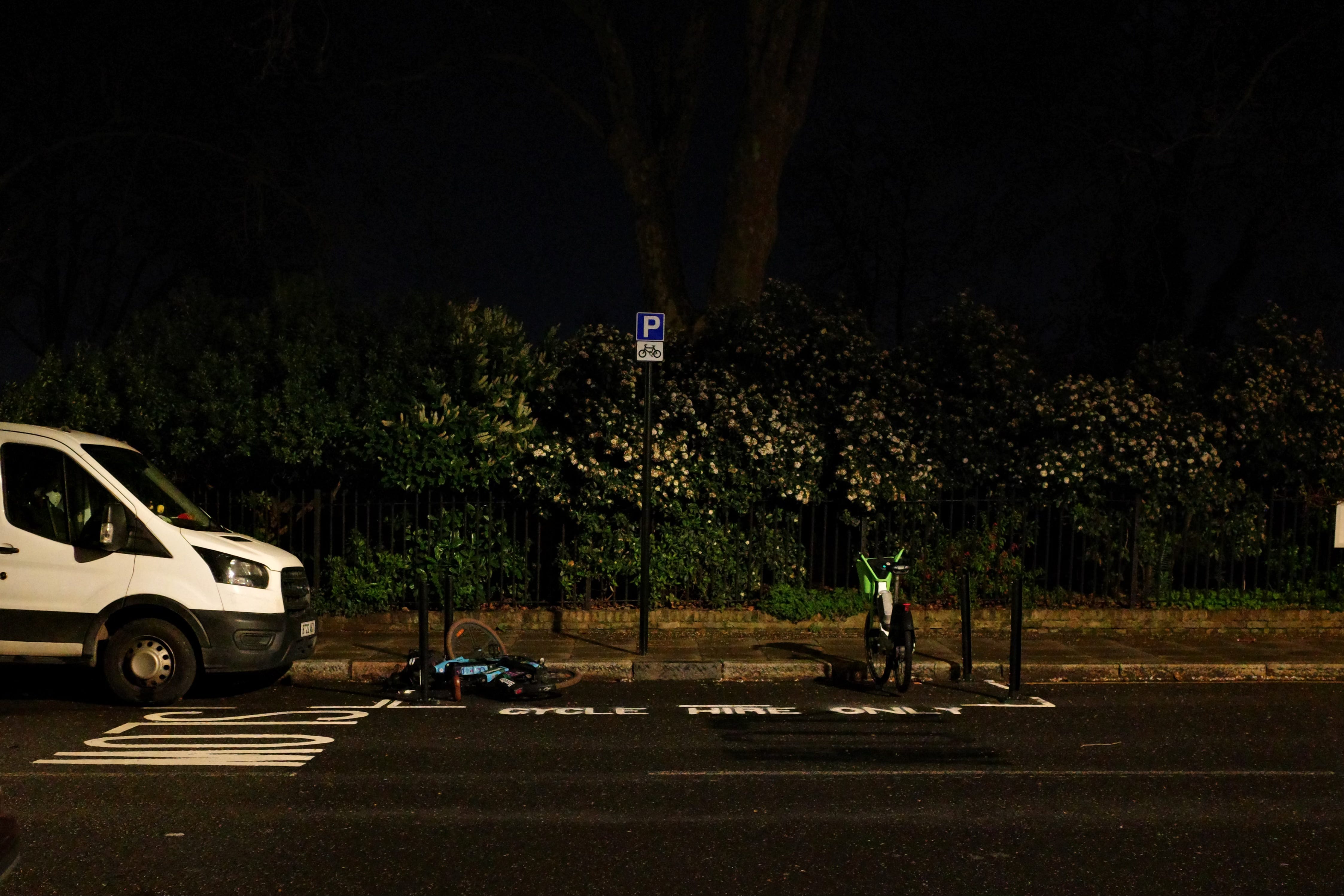
Toby has arrived, as he must have known he would, at the place where the old man was accosted. It must be the place: the whitewashed wall, the streetlamp. There is no sign that anything happened here. The only unexpected thing is a hire bike, tipped on its side in front of the far pavement. Whatever took place left no mark.
He is about to leave when a sound stops him. The pitch repeats, intense, high. He walks backwards, searching for the source, then forwards two paces. The cry comes from a patio garden belonging to the whitewashed house. A plastic device flashes in a plant pot, blinking red. To deter birds, Toby decides.
He raises his phone. On the screen there’s nothing to see: a wall, a plant pot, a metal railing, a veiled window. Instead, he photographs the hire bike, thinking of Chris’s case, the tribunal. Chris had tried to argue there was sexism at play, but Maddie wouldn’t allow it, since the panel was three women. “You know the flaws in your own case the best,” Chris said.
Toby wondered how he’d break it to Fi about Madeleine. And he imagined describing his cowardice. Fi would be practical, dismissive of his guilt, of the tears springing to his eyes. He’d done nothing wrong, she’d reassure him. If he told her. He opened his photos and deleted the fridge, the canal, the bike. You are not the victim, he said to himself.
A noise behind caught his attention. A dog in a cone had nosed its way under the blind. The dog was brown and white with shaggy ears. A family dog, feeble, injured. Its big eyes watched Toby’s camera. Paws on the sill, the cone, the wet stare. Toby’s reflection, the ghost in the glass.
Hesitantly, as if out of duty, the dog bared its teeth. With no malice in its expression, even with resignation, it lifted its muzzle and barked, barked, barked.
Thanks for reading One More Draft! Pocket Lint is a nutritious weekly serial, fortified with trivia and nonsense, now available in a convenient fictional wrapper. If you didn’t enjoy this post, be sure to miss the complete Pocket Lint Archive, and do comment and share to help others avoid my work.
Until next week, with warmth and gratitude,
LW
Ominous and very compelling. Beautiful imagery here. 'You deserve somebody who cares enough to stop the lap dance' is brilliant. x
This carried me into a mood & space that was entirely appropriate for a Sunday morning. Thank you.